Design Where Roads End
Earth silently Assists every vehicle we build: atmospheric air convects heat off brake discs and motor windings, oxygen regrows protective oxide skins on steel gears, and liquid water tumbles sharp quartz sand into smooth grains. Remove Earth's atmosphere and hydrosphere, and ordinary machine elements destroy themselves in hours.
Mission Design Constraints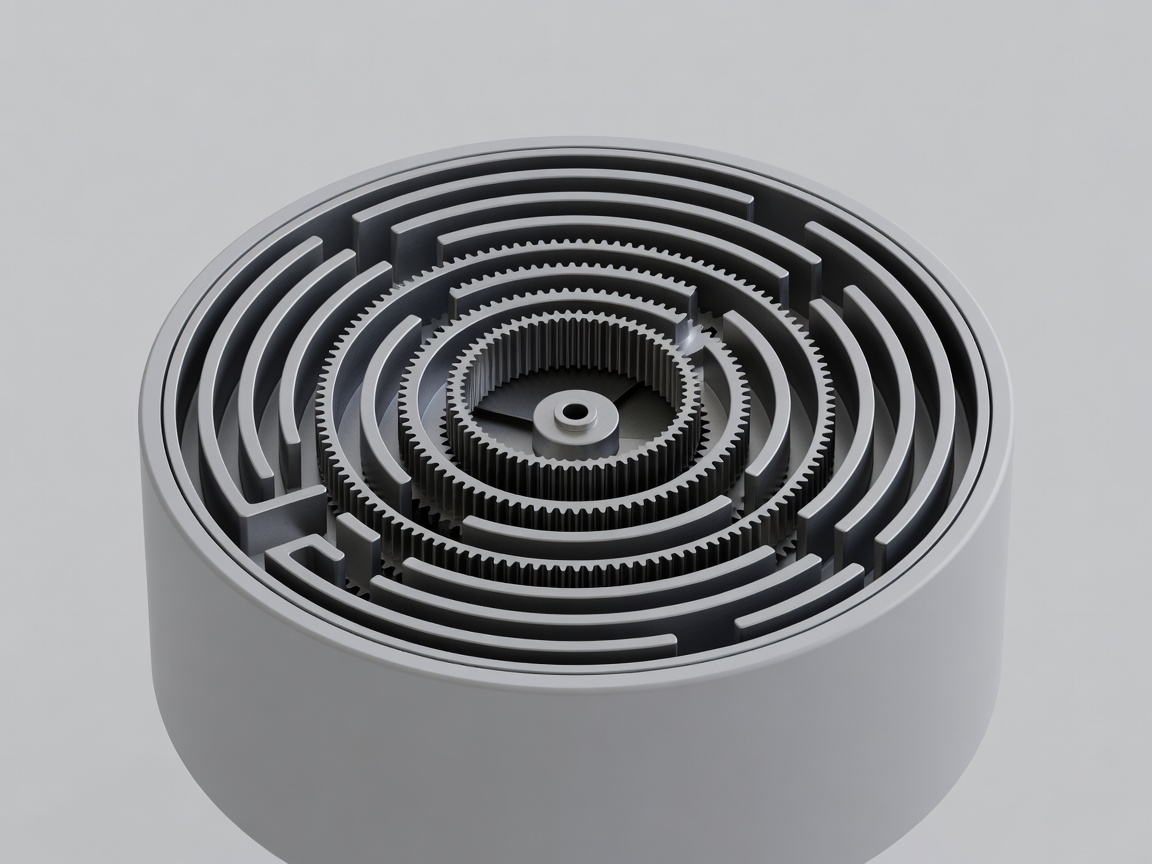 3D Engineering Render • Sealed Hub & Dust Labyrinth
The Regolith & Electrostatic Dust Problem
Ask any Apollo astronaut—from Gene Cernan to Harrison Schmitt—what surprised them most about working on the Moon, and the answer is almost always dust.
Four billion years of micrometeoroid bombardment without wind or water erosion pulverized lunar anorthosite and mare basalt into a poorly sorted silt with a median grain size between 40 and 130 micrometers, including a pervasive fraction below 10 micrometers. Microscopic impacts melt tiny droplets of silicate glass that weld sharp mineral shards into jagged, interlocking structures called agglutinates, rated 6 to 7 on the Mohs hardness scale—harder than structural aluminum and stainless steel.
Worse, solar ultraviolet photons knock electrons off illuminated grains on the dayside, giving dust a positive electrostatic charge, while solar-wind plasma charges nightside grains negatively. Dust literally clings to optical lenses, camera barrels, spacesuit wrist disconnects, and radiator mirrors. On Apollo 17, after Cernan's hammer handle accidentally snapped the right rear fender extension off LRV-3, "rooster tails" of dark grey regolith showered the rover's upward-facing fused-silica mirrors. Because dark dust absorbs 90% of incident sunlight instead of reflecting it, the rover's electronics and battery temperatures climbed dangerously toward operational limits until Houston engineers devised a replacement fender from four laminated photomaps and two cabin lamp clamps.
Hard Vacuum, Cold-Welding & Heat Rejection
How do you lubricate a drivetrain at 10-12 torr when grease boils away, and how do you cool an electric motor with zero air molecules?
Conventional hydrocarbon oils outgas volatile vapors in vacuum that condense onto cold optical sensors, while graphite—a superb dry lubricant on Earth—actually requires adsorbed water vapor molecules between its carbon sheets to slide smoothly; in lunar vacuum, graphite becomes an abrasive! Space drivetrains rely on sputtered molybdenum disulfide (MoS₂), tungsten disulfide, lead/silver soft-metal films, or ultra-low-vapor-pressure perfluoropolyether (PFPE) synthetic fluids sealed inside pressurized nitrogen wheel hubs (Apollo LRV wheel drives were hermetically sealed with 51 kPa nitrogen gas).
Without air convection, a hot brake rotor or motor casing can shed heat only by thermal conduction into thermal sinks (such as melting paraffin-wax phase-change blocks used on the Apollo LRV) or infrared radiation into deep space governed by P = εσAT4. During lunar noon, surrounding crater walls radiate infrared heat back onto the vehicle at +120°C, forcing upward-facing optical solar reflectors with bimetallic thermal straps that snap open only after sunset when temperatures plunge toward -173°C (or -240°C inside permanently shadowed polar craters).
If vacuum freezes batteries, Venus melts silicon. At 465°C and 92 atmospheres of supercritical carbon dioxide, conventional lithium batteries explode and silicon CMOS microchips lose their bandgap behavior. NASA Glenn's speculative ARED / AREE (Automaton Rover for Extreme Environments) study proposes a clockwork wind-driven mechanical rover using high-temperature Savonius wind turbines, mechanical Babbage-style obstacle bumpers, and silicon-carbide (SiC) electronics rated for 500°C.
Mass Penalty, Latency & Crew Safety Envelopes
Every kilogram of rover landed on the lunar surface requires roughly 6 to 10 kilograms of propellant and stage mass in Low Earth Orbit—a harsh multiplier known as the rocket equation gear ratio.
| Constraint Domain | Moon (Equatorial / Polar) | Mars Surface | Titan Surface |
|---|---|---|---|
| One-Way Radio Delay | 1.28 seconds (near-real-time teleoperation possible) | 4 to 22 minutes (autonomous hazard avoidance mandatory) | 68 to 88 minutes (full onboard flight autonomy required) |
| Night Duration | ~354 hours equatorial; variable polar illumination | ~12.3 hours (manageable with Li-ion heaters) | ~192 hours (nuclear MMRTG strongly favored) |
| Crew Safety Rule | Suit walk-back (~7.6–10 km max radius) or paired rovers | Redundant pressurised rovers or pre-deployed ascent vehicle | Uncrewed robotic regime only |