Dossier 02 • Crewed Planetary & Orbital Mobility

Getting Astronauts Around

Human explorers bring geological intuition that no teleoperated camera can match, yet humans also carry strict metabolic clocks. Every crewed space vehicle—whether a folding 210 kg lunar buggy, a nitrogen-thruster backpack, or a ten-ton pressurised cruiser—is fundamentally a life-support range extender.

Flown & Funded Architectures
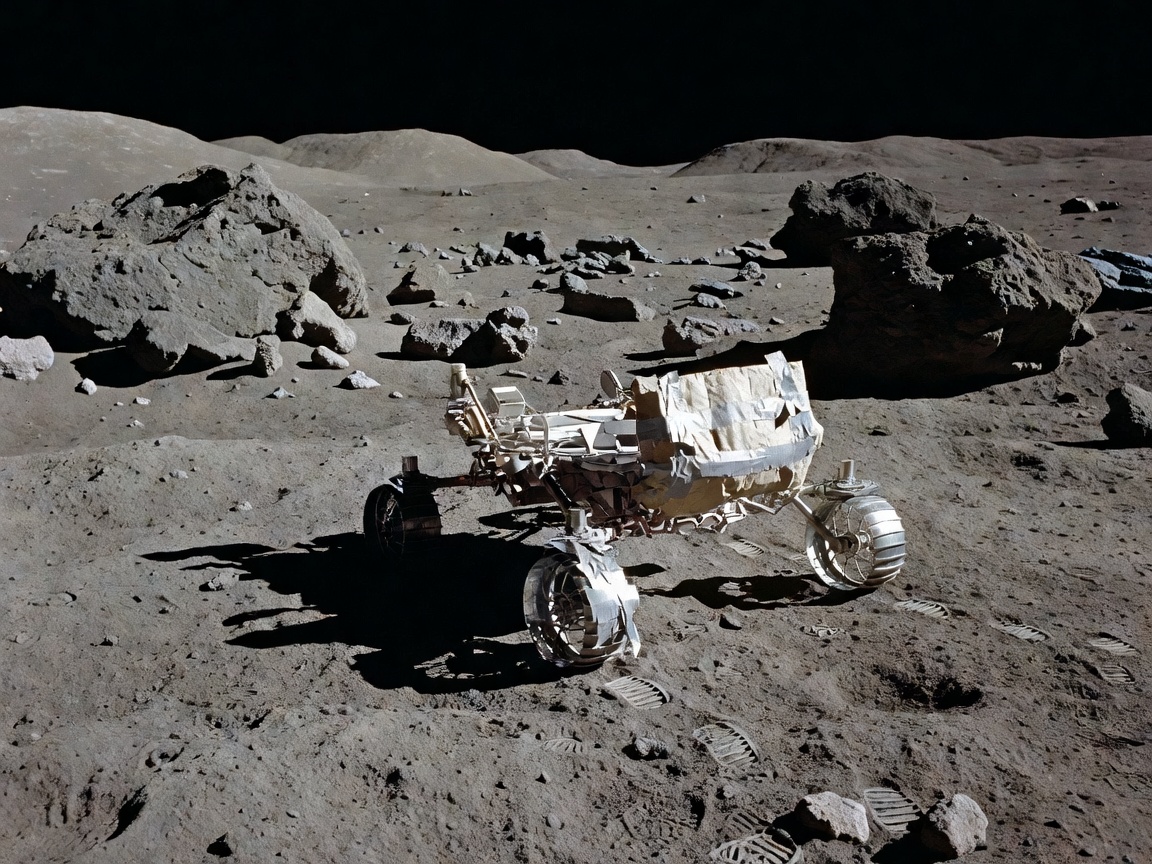
Verified flight photograph of the Apollo 17 Lunar Roving Vehicle parked near boulder fields in the Taurus-Littrow valley with improvised fender repair Verified Flight Photo • Apollo 17 LRV-3
Flown Benchmark (1971–1972)

The Apollo Lunar Roving Vehicle

Only three crewed wheeled vehicles have ever operated on another world, and all three remain parked on the Moon today: LRV-1 at Hadley-Apennine, LRV-2 at Descartes, and LRV-3 at Taurus-Littrow.

Flown Hardware

Origami Packaging Inside Quadrant 1

To fit inside a triangular bay of the Lunar Module Descent Stage measuring barely 1.5 meters tall, Boeing and GM engineers hinged the 3.1-meter tubular 2219-aluminum chassis into three sections with torsion-spring deployment struts. Pulling two nylon lanyards allowed astronauts on the surface to unfold the chassis and snap all four wheels into place within twenty minutes.

Because thick spacesuit gloves cannot grip a conventional steering wheel or floor pedals, astronauts controlled speed, front-and-rear Ackermann steering, and mechanical drum brakes via a single central T-handle controller positioned between the tubular lawn-chair seats. Navigation relied on a directional gyroscope and wheel-rotation odometer—there is no global lunar magnetic dipole for a compass and no GPS constellation overhead.

Earth Mass210 kg
Payload Capacity490 kg (2.3× mass)
Wheel Motors4 × 0.25 hp (186 W)
Gear Reduction80:1 Harmonic Drive
Batteries2 × 36 V AgZn (121 Ah)
Top Recorded Speed18 km/h (Eugene Cernan)

Ferenc Pavlics's GM team solved the tire problem with an 81-centimeter spun-aluminum rim wrapped in woven zinc-coated steel piano wire (800 strands per wheel) topped by titanium chevron tread strips covering 50% of the contact area so dust fell cleanly back to the surface instead of clogging the mesh.

Proposed Vehicles • South Pole Operations

Unpressurised Rovers Built to Survive Lunar Night

Apollo rovers operated in bright near-equatorial morning sunlight for three days and were abandoned when crews lifted off. Modern lunar exploration targets the South Pole—around Shackleton and de Gerlache craters—where the Sun skims 1.5 degrees above the horizon, casting pitch-black shadows at -200°C across water-ice traps.

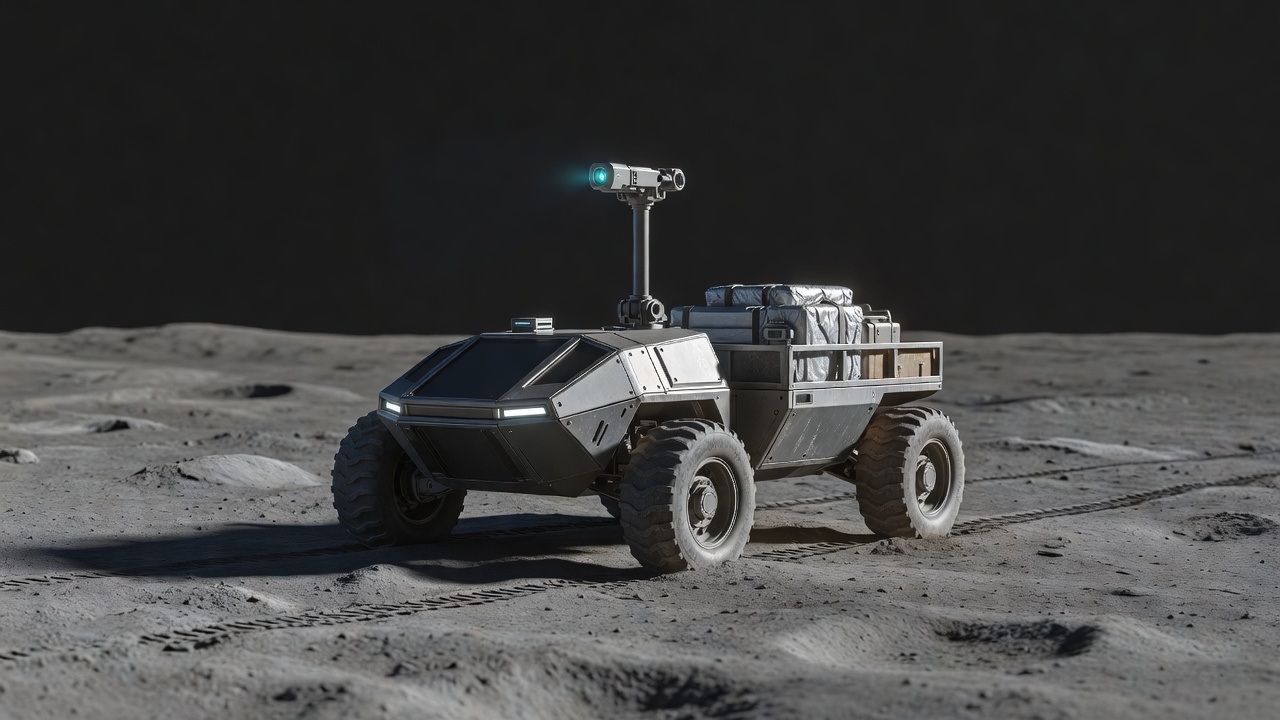
Soft-lit 3D render of a proposed Artemis-class Lunar Terrain Vehicle operating unmanned with robotic mast lidar and cargo bed on a plain background 3D Render • Dual-Mode LTV Architecture
Proposed Vehicle NASA LTV Services Program

Crew-Driven by Day, Robotic Geologist Between Landings

In 2024, NASA selected industry teams led by Intuitive Machines, Lunar Outpost, and Venturi Astrolab to advance Lunar Terrain Vehicle designs. Unlike Apollo's disposable buggies, these rovers must carry two suited astronauts for up to 20 km per sortie and then transition into teleoperated robotic science platforms during the months between human missions—surviving multi-day eclipses with rechargeable lithium-ion batteries and active thermal louvers.
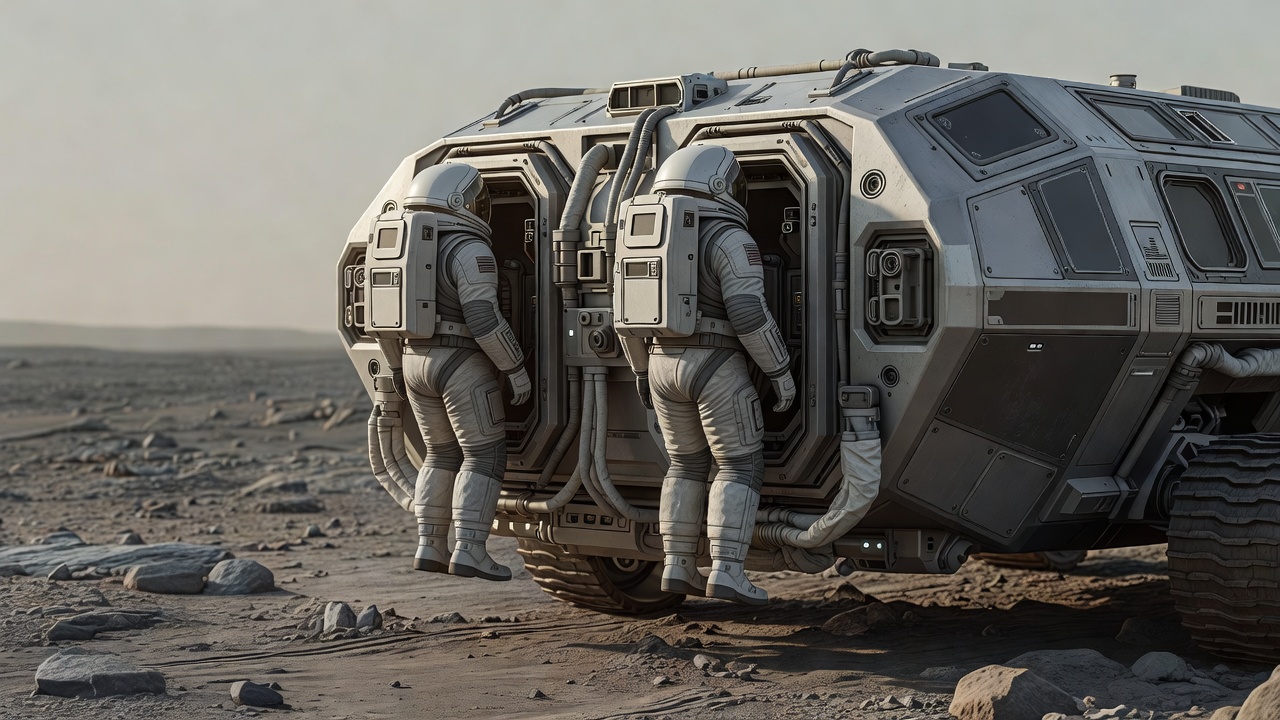
Soft-lit 3D render of rear suitport hatches on a pressurised planetary rover showing two external spacesuits mounted flush to the bulkhead 3D Render • Aft Suitport Bulkhead
Proposed & Field-Tested NASA SEV & JAXA Lunar Cruiser

Pressurised Cabins & The Suitport Breakthrough

Pumping down a conventional airlock wastes precious cabin gas and brings carcinogenic dust indoors on suit boots. NASA's field-tested Space Exploration Vehicle (SEV) and the JAXA/Toyota Lunar Cruiser solve both issues with aft suitports: spacesuits hang externally on the rear bulkhead, and astronauts climb directly into the suit's open backpack hatch from inside the cabin, sealing dust permanently outside while cutting EVA prep from hours to ten minutes.

Free-Space Crew Transport

Personal Thruster Packs & Lunar Flyer Studies

Wheels require ground contact. In orbital microgravity—and in historical emergency concepts for rugged lunar craters—crew mobility leaves the ground altogether.

Flown Hardware (1984)

Manned Maneuvering Unit (MMU)

Flown untethered by Bruce McCandless II and Robert Stewart on STS-41-B, and used later that year to capture spinning communication satellites, the 148 kg Martin Marietta MMU used 24 cold-gas nitrogen thrusters arranged for six-degree-of-freedom translation and rotation, operated via fingertip hand controllers.

Flown Safety Gear

SAFER Self-Rescue Pack

After Shuttle satellite-retrieval flights ended, NASA replaced the bulky MMU with SAFER (Simplified Aid For EVA Rescue)—a compact 38 kg nitrogen-jet collar clipped below the ISS spacesuit backpack, holding roughly 3 m/s of delta-v solely to return an accidentally detached astronaut to station handrails.

Historical Prototype

Bell Lunar Flying Vehicle Studies

Before selecting the wheeled LRV, NASA contracted Bell Aerosystems to study rocket-propelled "Lunar Hoppers" burning residual Lunar Module hypergolic propellants to leap into steep volcanic calderas. Engineers shelved the hopper because a single valve failure hundreds of meters up offered zero glide ratio in vacuum and violated walk-back crew safety.