Dossier 03 • Robotic Surface & Aerial Machines

Wheels for Other Worlds

No vulcanized rubber tire has ever rolled across another planetary surface—Save for the two modified aircraft tires bolted under the Soviet Lunokhod design's earliest Earth test rigs and the Space Shuttle's runway landing gear. Beyond Earth, wheels are metallic sculptures engineered to flex like springs without air.

Robotic Terramechanics
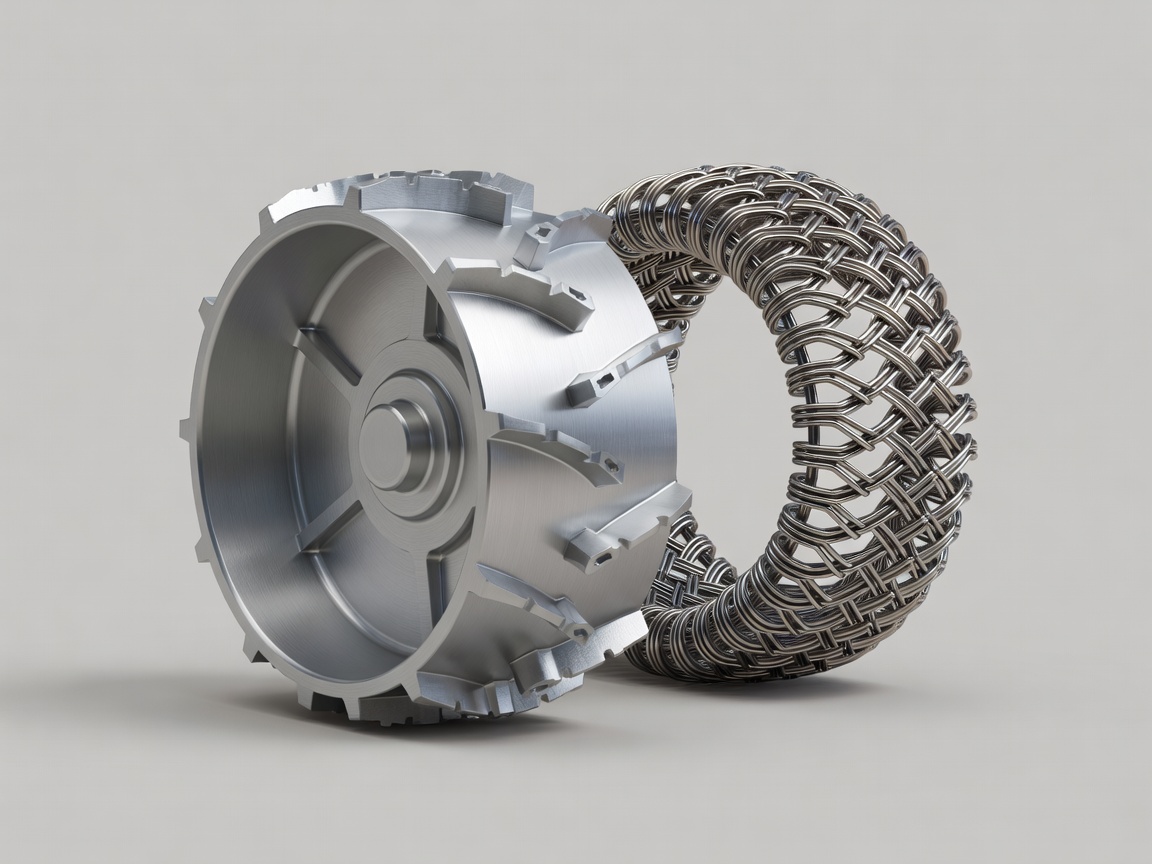
Soft-lit 3D render of a machined aluminum Mars rover wheel alongside a woven nitinol spring tire assembly on a plain background 3D Engineering Render • Solid vs. Mesh Wheel Study
Flown Mars Lineage (1997–Present)

Rocker-Bogie Kinematics & Wheel Evolution

From the 11.5 kg Sojourner in 1997 through Spirit, Opportunity (which drove 45.16 km over 14 years), Curiosity, and Perseverance, NASA's Jet Propulsion Laboratory refined a passive six-wheel linkage that needs zero coil springs.

Flown Hardware

Equalizing Ground Pressure Over Two-Wheel-Diameter Obstacles

A conventional sprung automobile chassis pitches violently if one front wheel climbs a boulder twice its radius, unloading the opposite wheel and stalling traction. The rocker-bogie suspension connects each side's three wheels via a pivoted bogie and main rocker arm linked across therover belly by a differential bar. When the front left wheel climbs a 40-centimeter rock, the main body tilts by only half that angle while all six wheels maintain near-equal downward force.

Why do Mars rovers crawl at roughly 150 meters per hour (4.2 cm/s)? Because an unsprung linkage cannot absorb high-speed shock impulses—and because radio round-trip light time between Earth and Mars ranges from 8 to 44 minutes, demanding onboard stereo-vision hazard avoidance (`AutoNav`) to evaluate every meter of terrain.

Lessons From Curiosity's Punctured Treads

To save mass on the 899 kg Curiosity rover, engineers milled its 50-centimeter aluminum wheels down to a skin thickness of just 0.75 millimeters between aggressive zig-zag chevron cleats. When Curiosity crossed cemented, razor-sharp sandstone "ventifacts" in Gale Crater, the Differential linkage inadvertently pushed trailing wheels horizontally into rock points, tearing aluminum skin panels.

For Perseverance, engineers narrowed wheel width, increased diameter to 52.5 centimeters, doubled skin thickness, and replaced sharp chevrons with 48 gently curved cleats.

Material Science & Mesh Assemblies

From Piano Wire to Shape-Memory Nitinol

Compliant mesh wheels offer far larger contact patches in loose soil than rigid aluminum drums, provided the metal wire does not plastically yield after thousands of flex cycles.

Flown Hardware Lunokhod & Yutu-2

Spoked Titanium & Sieve Mesh

Alexander Kemurdzhian's team at VNIITransmash designed Lunokhod's eight rigid-hubbed wire-mesh wheels with bicycle-like tangential titanium spokes and titanium cleats. If a motor seized in vacuum, a tiny explosive squib sheared the drive axle so the wheel could free-wheel rather than drag like an anchor. China's 140 kg Yutu-2 uses six sieve-mesh wheels on the lunar far side inside Von Kármán crater.

Lab & Field Tested NASA Glenn Research Center

Superelastic Nitinol Spring Tires

Ordinary spring steel permanently bends beyond ~0.5% strain. Nickel-titanium (Nitinol) stoichiometric alloys undergo a reversible stress-induced phase shift between austenite and martensite crystals, allowing up to 10% elastic deformation—thirty times more than steel. Coiled nitinol tires can deform right down to the axle over jagged basalt and snap cleanly back into roundness.

Flown Hardware Asteroid Ryugu (0.00015 m/s²)

MINERVA-II & MASCOT Hoppers

On asteroid Ryugu, gravity is one sixty-thousandth of Earth's. Any wheel torque immediately launches a rover into slow-motion freefall. JAXA's 1.1 kg MINERVA-II rovers and DLR/CNES's MASCOT eliminated wheels completely, spinning internal eccentric flyweights to hop gracefully across boulder fields in 15-minute ballistic arcs.

Beyond Conventional Wheels

Rappelling Axles, Nuclear Rotorcraft & Ice Eels

The richest scientific targets in the solar system—lunar skylight pits, Titan's methane dunes, and Enceladus's icy vents—require architectures far removed from four-wheeled buggies.

Proposed Mission Titan (Launch Planned)

Dragonfly Nuclear Octocopter

Saturn's moon Titan combines 0.138 g gravity with a nitrogen atmosphere four times denser than Earth's at sea level. Flying is roughly 38 times easier aerodynamically than on Earth. JHU APL's car-sized Dragonfly rotorcraft uses an MMRTG nuclear generator to charge batteries between multi-kilometer flights across organic sand dunes.

Field Prototype JPL DuAxel Concept

DuAxel Tethered Cliff Climber

To sample vertical Martian recurring slope lineae or lunar lava-tube skylights, JPL's DuAxel four-wheeled rover anchors its rear half firmly into flat ground while the front two-wheeled axle detaches and rappels down 70-degree cliffs on an electromechanical power-and-data tether.

Speculative Prototype JPL EELS Study

EELS Serpentine Ice Explorer

Tested on terrestrial glaciers, the Exobiology Extant Life Surveyor (EELS) chains rotating screw-threaded segments into a four-meter robotic snake capable of corkscrewing horizontally across powdery snow or bracing outward to descend narrow crevasses such as those envisioned on Saturn's moon Enceladus.