Dossier 01 • Human-Powered Off-World Mobility

Pedalling on the Moon

On Earth, a human on a bicycle is the most energy-efficient travelling organism ever measured, expending roughly 0.15 kilocalories per kilogram per kilometer. That remarkable efficiency inspired early lunar mission planners to ask a deceptively simple question: if payload mass to the Moon costs tens of thousands of dollars per kilogram, why carry heavy batteries when astronauts bring two legs?

Historical Studies & Speculative Designs
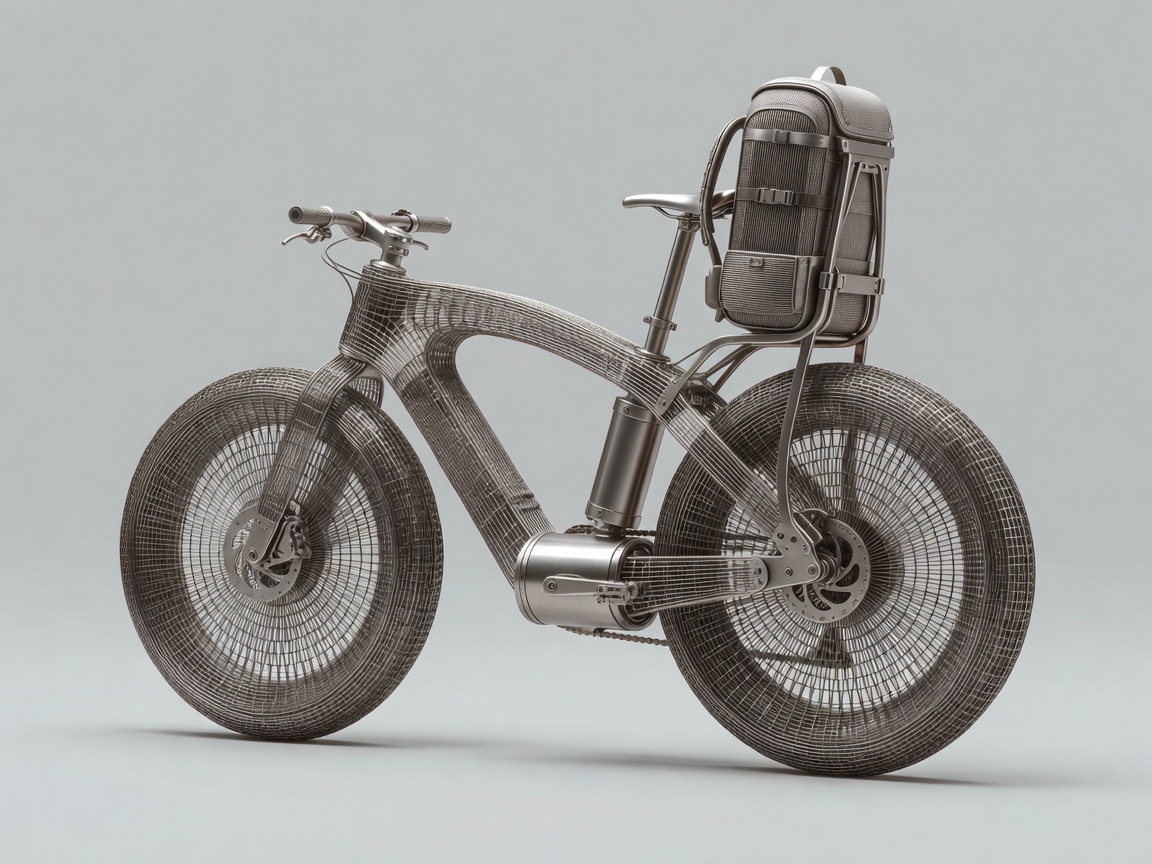
Soft-lit 3D render of an experimental lunar cycle concept featuring wide woven titanium mesh wheels, enclosed shaft drive, and upright backpack cradle on a plain background Speculative Concept Render • Shaft-Drive Lunar Cycle
Vehicle Dynamics in 1.62 m/s²

The Physics of One-Sixth Gravity

To understand why an Earth gravel bike cannot simply be strapped to a lunar lander, separate weight from mass. Mass (measured in kilograms) governs momentum and kinetic energy; weight (mass multiplied by local gravitational acceleration) governs tire normal force and maximum traction.

Cornering Radius Multiplies Sixfold

Maximum lateral friction equals the friction coefficient (μ) times normal force (m ċ g), while required centripetal force remains m ċ v² / r. Because g on the Moon is 1.62 m/s² rather than 9.81 m/s², the minimum safe turning radius at 18 km/h (5 m/s) balloons by a factor of six—even before accounting for loose, powdery silicate dust reducing μ below 0.35.
Ballistic Lofting Over Cobbles

Striking a 6-centimeter rock at 4 m/s imparts an upward vertical velocity impulse to wheel and frame. Under Earth gravity, the tire returns to the ground in tens of milliseconds. Under lunar gravity, hang-time stretches six times longer, leaving the front wheel unsteerable in vacuum until touchdown.

High Center of Mass

A Portable Life Support System (PLSS) backpack shifts the suited rider's center of mass upward and aft. Under hard front-wheel braking on a diamond bicycle frame, pitch-over instability occurs at tiny decelerations, while rear-wheel braking merely skids across regolith without shedding speed.

1960s EVA Trade Studies

Why Spacesuit Kinematics Ruled Out Pedal Rovers

During pre-Apollo surface mobility evaluations at NASA Langley Research Center and Manned Spacecraft Center, engineers tested reduced-gravity walking rigs (such as Donald Hewes's inclined-plane lunar gravity simulator) alongside small wheeled scooters and pedal concepts. The decisive limitation was never human cardiovascular fitness; it was the mechanical work wasted flexing a gas-pressurised suit.

An Apollo A7LB suit operated at roughly 25.5 kPa (3.7 psi) pure oxygen, while next-generation exploration suits operate near 29.6 to 56.5 kPa. Bending a pressurised fabric cylinder slightly decreases its internal volume, requiring the astronaut's quadriceps and hip flexors to compress the breathing gas on every pedal stroke. Even when constant-volume convolute joints and rotary waist bearings are added, sustained cyclic hip flexion at 60 to 80 RPM generates roughly 500 to 700 watts of metabolic heat.

On the Moon, heat cannot be shed by breeze or sweat evaporating into ambient air. Every watt of rider heat must boil sacrificial cooling water into vacuum through the suit's sublimator or membrane evaporator. A five-kilometer pedal sprint could consume more cooling water mass than the battery mass saved by omitting an electric hub motor—which is precisely why electric wheel drives won the Apollo Lunar Roving Vehicle contract.

Apollo Suit Pressure25.5 kPa (3.7 psi)
Walking Metabolic Rate250–320 W
LRV Driving Rate~145 W
Suited Pedal Estimate520–680 W
Flown Space Cycles

Where Space Bicycles Actually Flew: Orbital Ergometers

While wheeled bicycles stayed on Earth, stationary pedal machines became indispensable flight hardware aboard virtually every long-duration orbital station since 1973.

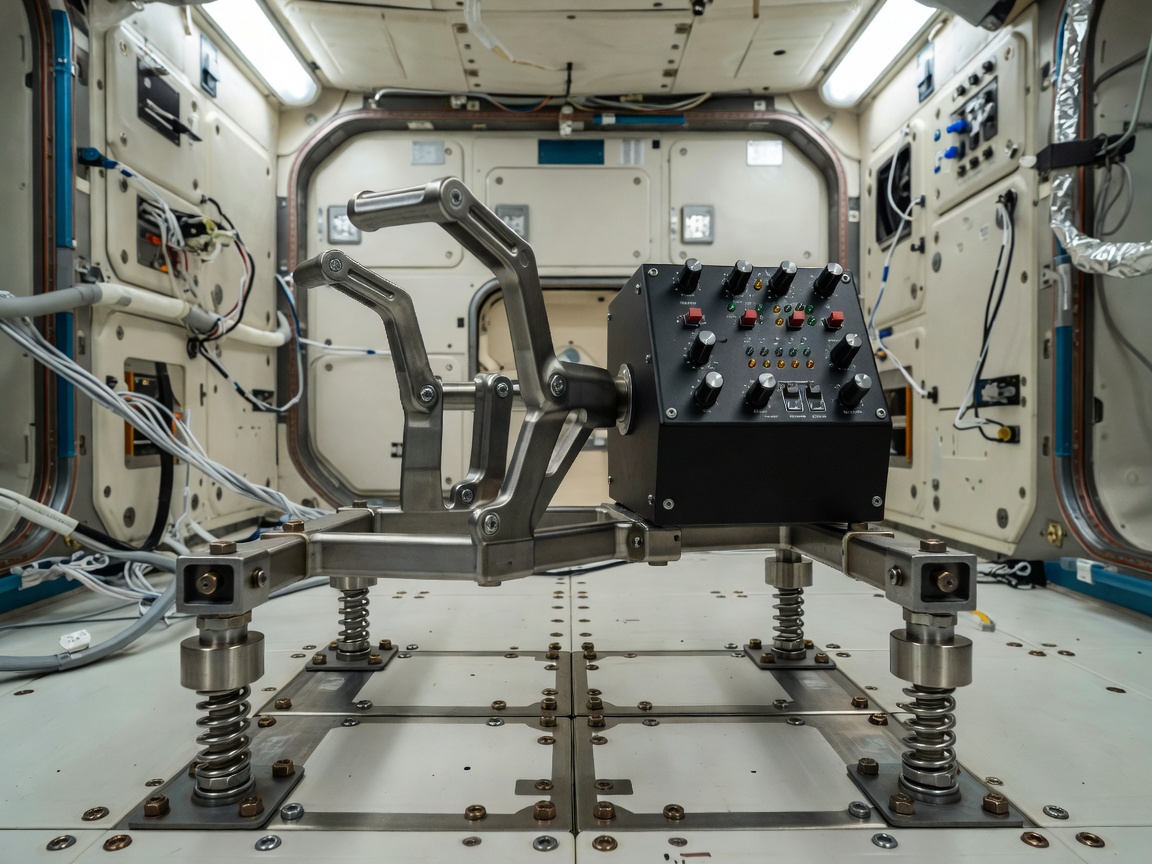
Verified flight hardware photograph of an orbital cycle ergometer showing clipless pedal cranks, workload control box, and floor isolation struts Flown Station Hardware • Orbital Ergometer
Flown Hardware

Skylab M171, Mir Veloergometer & ISS CEVIS

Aboard Skylab in 1973–1974, astronauts Charles Conrad, Owen Garriott, and their successors pedalled a calibrated cycle ergometer for medical experiment M171, proving that vigorous daily cycling preserved aerobic capacity (VO₂ max) in weightlessness. Soviet Salyut and Mir crews relied on rugged brush-braked veloergometers.

On the International Space Station, the Danish-built CEVIS (Cycle Ergometer with Vibration Isolation and Stabilization System) removes the seat post entirely. Crew members clip cycling shoes into the pedals, hold stabilizing handgrips or recline against a dorsal pad, and spin up to 250 watts while spring-damped struts keep 1–2 Hz pedalling harmonics from shaking delicate crystal-growth and telescope payloads.

Meanwhile, ground centrifuge studies—including MIT's compact Twin-Bike artificial-gravity experiments—have tested human-powered short-radius centrifuges where two astronauts pedal around an interior circular track inside a cylindrical deep-space module to combine aerobic conditioning with hypergravity bone loading.

Speculative Concepts • Clearly Labelled

Three Plausible Roles for Future Lunar Cycles

When we strip away spacesuit resistance or constrain wheel geometry, human-powered machines re-enter legitimate architectural studies for long-term lunar bases.

Speculative Concept Pressurised Lava Tube

1. Shirt-Sleeve Tunnel & Dome Cycles

Inside a 2-kilometer sealed lunar lava tube or inflatable corridor network pressurised to 70 kPa, astronauts wear light athletic clothing. Here, a 6 kg aluminum utility bike or cargo trike eliminates exhaust, spark risk, and battery charging infrastructure while doubling as mandatory daily cardiovascular exercise.

Speculative Concept Banked Parabolic Ring

2. Artificial-Gravity Velodromes

Riding at 10 m/s (36 km/h) around a steeply banked circular track of 12-meter radius produces 8.33 m/s² of centripetal acceleration. Vector-summed with lunar gravity (1.62 m/s²), the rider experiences 8.49 m/s²—nearly 87% of Earth weight—providing mechanical loading to femoral necks and lumbar vertebrae while staying agile.

Speculative Concept Emergency Tethered Rail

3. Cable-Guided Emergency Hand-Trolleys

Between a nuclear power reactor and a habitat 1.5 km away, a tensioned stainless-steel guide cable or lightweight monorail truss allows an unpowered, hand-cranked rescue trolley to move a suited astronaut using upper-body shoulder bearings without regolith rolling resistance.